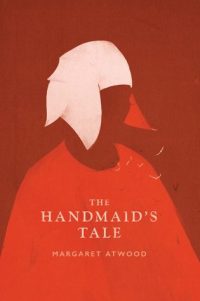
 I’m not sure I can give a proper review, but I’ve finally made it halfway through. This has been a difficult and disappointing read for me. And let me tell you why!
- I have a really hard time buying into Atwood’s dystopia. It’s just not realistic for me in so many different ways, every time I talk about it I find myself in even more disbelief. In three years Offred is “taken,” indoctrinated (even though she is not really, as evidenced by her constant internal dialogue, and as such it is therefore hard to believe that anyone else has actually been indoctrinated), and has served as a handmaiden in three separate households. I feel like Lumière: Sacré bleu!
The commander, his wife, and Offred all participate in several ritual ceremonies. But at whose bidding? Who is compelling them? Is it their new “indoctrinated” beliefs? Is it the “army” that supposedly controls things, and yet. And yet by the middle of the book no one seems to be following any of the rules. I mean, women are no longer meant to read and she has a pillow in her room with a word on it. And the commander has a “man” room that women are not supposed to go into, and they apparently just do not? And anyway, he invites Offred to play “sex” scrabble [“To be asked to play Scrabble, instead, as if we were an old married couple, or two children, seemed kinky in the extreme, a violation in its own way.”] in this secret room. Not to mention good ole Mrs. Commander helping Offred with her clandestine relationship with Nick. Right, another man with whom she is not following the rules.
I mean, rules? Anyone? Is anyone really following or enforcing the rules? Are we meant to believe this society exists because outside pressure is forcing it upon the society, or are we meant to believe this society exists because the entire community has been “indoctrinated,” which Atwood effectively demonstrates never really happens to any of the characters.
The entire dystopia is falling apart even as it’s being established, as demonstrated by the rebellion group that (after three years) already helps Offred escape. And yet, reader review after reader review keeps talking about how the disturbing thing about this book is that it echoes our world and could actually happen just like this. What now? *smh*
- For all the talk about this being a “must read” feminist book, I have yet to discover any consistent or coherent thoughts on feminism. There is not yet any strong or clear argument, and perhaps this is intentional. But it doesn’t make me ponder, “What exactly is feminism?” Rather, it feels confused, as if Atwood has no cohesive thoughts to communicate.
- And the frustrating thing is that sometimes, Atwood drops great one-liners: “Ordinary,” said Aunt Lydia, “is what you are used to. This may not seem ordinary to you now, but after a time it will. It will become ordinary.”
But then she goes on nonsensical, rambling tangents that often include weird sexual innuendos:
To be a man, watched by women. It must be entirely strange. To have them watching him all the time. To have them wondering, What’s he going to do next? To have them flinch when he moves, even if it’s a harmless enough move, to reach for an ashtray perhaps. To have them sizing him up. To have them thinking, He can’t do it, he won’t do, he’ll have to do, this last as if he were a garment, out of style or shoddy, which must nevertheless be put on because there’s nothing else available. To have them putting him on, trying him on, trying him out, while he himself puts them on, like a sock over a foot, onto the stub of himself, his extra, sensitive thumb, his tentacle, his delicate, stalked slug’s eye, which extrudes, expands, winces, and shrivels back into himself when touched wrongly, grows big again, bulging a little at the tip, traveling forward as if along a leaf, into them, avid for vision. To achieve vision in this way, this journey into a darkness that is composed of women, a woman, who can see in darkness while he himself strains blindly forward. She watches him from within. We’re all watching him. It’s the one thing we can really do, and it is not for nothing: if he were to falter, fail, or die, what would become of us? No wonder he’s like a boot, hard on the outside, giving shape to a pulp of tenderfoot. That’s just a wish. I’ve been watching him for some time and he’s given no evidence, of softness. But watch out, Commander, I tell him in my head. I’ve got my eye on you. One false move and I’m dead. Still, it must be hell, to be a man, like that.
I mean, what now?
Or, she ends a description of Offred defending herself against attack by the Commander with, “I think about the blood coming out of him, hot as soup, sexual, over my hands.” I mean, really. What?
It’s like a roller-coaster-of-randomness thrown in amidst something that could potentially have been good writing. *sigh*
Oh, are you still here? Thank you for sticking with me for so long! There is also the possibility that this book is just too deep for me. 🙂

 Caryn Considers